
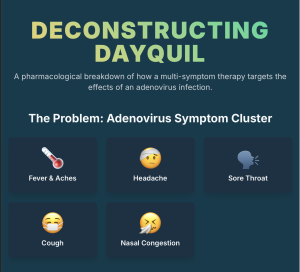
A Pharmacological Analysis of Dayquil’s Active Ingredients in the Symptomatic Management of Adenovirus Infection

Introduction Adenoviruses are a ubiquitous class of non-enveloped DNA viruses that represent a significant etiologic agent of acute respiratory illnesses in humans.1 These infections manifest across a wide clinical spectrum, ranging from the mild symptoms of the common cold to more severe conditions such as bronchitis and pneumonia.3The clinical presentation of a viral infection, including that caused by adenovirus, is not solely a result of direct viral cytotoxicity but is largely a consequence of the host’s innate immune and inflammatory response to the pathogen. This response, while crucial for viral clearance, generates the familiar and distressing symptom cluster of fever, pain,


> Read More

The Myth of The ‘Mid-life Crisis’

[This entry is submitted by our pre-med leader, Skylar. Click here to learn more about Skylar and her projects.] The Mid-life crisis is a long time belief that society is hung onto despite research that indicates different. This belief is demonstrated by the ‘U-shaped happiness curve’ which dictates that one can only achieve happiness AFTER a crisis. The reality is that time shifts perspective. Psychologists, Sophie Hoehne and Daniel Zimprich discovered that a dip in happiness isn’t what occurs, but people begin to prioritize different goals to maximize their own happiness. This comes with growth overtime and is completely natural. 

> Read More
Cigarette smoke

ADHD and Nicotine

[This entry is submitted by our pre-med leader, Skylar. Click here to learn more about Skylar and her projects.] Recent studies suggest that there is a direct link between Attention Deficit Hyperactivity Disorder (ADHD), particularly in young subjects, and nicotine consumption. Nicotine is technically a stimulant that reduces the effects of ADHD, so when teens with ADHD begin smoking, it becomes exponentially harder for them to quit due to the benefits it offers them.  Currently, several large drug companies are working to separate the addictive component of the nicotine molecule from the desirable component . The problem they face is

> Read More
Cancer Screening

Whole body MRI: Risks vs Benefits in Cancer Screening

In our practice, it’s not uncommon to see patients with a health concerns or a family history of cancer. We’re not radiologists or oncologists, but we do treat a lot anxiety including health-related anxiety syndromes. Magnetic resonance imaging (MRI) has been widely used in the medical field for diagnostic purposes. With the advent of advanced MRI technology, whole body MRI has become a popular method for screening for cancer. This type of MRI scan involves taking images of the entire body to detect any signs of malignancy. However, like any medical procedure, whole body MRI has both risks and benefits,

> Read More

Eat the Rainbow: Why Blue and Purple Produce Matters

Nutritionists tell us that good nutrition isn’t just about eating your greens – the key to a balanced diet involves tasting each facet of the color wheel, including those often-neglected blue, purple, and black foods. Why? In addition to essential vitamins and minerals, colorful plant-based foods contain phytonutrients; natural chemicals known to be an extremely beneficial nutritional resource. Phytonutrients provide a host of protective factors that promote optimal organ function and aid the body in the prevention of chronic illness. Fruits, vegetables, legumes, and grains of all colors contain phytonutrients, but most folks neglect the unusual or unfamiliar colors, opting

> Read More

What does a D.O. really DO?

Overview A DO is a Doctor of Osteopathic Medicine. DO and MD are commonly seen as interchangeable titles. In fact, many people have been seen by DO without knowing it. However, the degrees differ both in training and practice. In the United States, a DO and an MD are very similar. They are both four-year medical degrees involving extensive internships, residencies and fellowships, and both are considered fully qualified and licensed physicians. This means they can both prescribe medication and pursue specialties including surgery, although due to the holistic nature of osteopathic medicine, DOs more commonly choose specialties like primary

> Read More

My Experience Participating in a COVID-19 Vaccine Trial

About the Guest Author: Angela Brinker, BS, MS has a Master’s Degree in Nutrition and Human Performance and currently works in a research support position. She is open to new work and is actively seeking a role in either health and wellness, nutrition, or a nutrition medical research lab. Find her on LinkedIn: www.linkedin.com/in/angela-brinker-researchnutrition. My Experience Participating in a COVID-19 Vaccine Trial I was one of the earliest recipients of a COVID-19 vaccine. Although I didn’t know whether I was given the active vaccine or the saline placebo at the time, I received my first dose of the Pfizer vaccine as

> Read More
Vitamin B5

Vitamin B5: What You Need to Know

What is Vitamin B5? Vitamin B5, also known as pantothenic acid, is a vital nutrient to the functioning of the human body. It plays multiple roles within the body and works in conjunction with other B-Vitamins to create energy by using fats and proteins. A family of eight in total, B Vitamins affect many areas of the body, including the skin, eyes, hair, liver, and nervous system. They are water-soluble vitamins, which means that they are not stored in the body and are in need of constant replenishment from foods and, in some cases, dietary supplements. Vitamin B5 plays an

> Read More

The Gut Microbiome: A Hidden Contributor to Mental Health

The importance of good bacteria in the gut has been a topic of interest for several years. A healthy gut biome is one that is diverse in good bacteria; it is essential to the body’s optimal functioning. From yogurts and fermented drinks to probiotic supplements, the health food industry is inundated with ‘good bacteria’ products. But just what are healthy bacteria, and how do they affect our bodies? What is the Gut Microbiome? The gut microbiome represents a community of trillions of bacteria living in the gut. These bacteria contribute to many bodily functions; they assist the body in breaking

> Read More

Alpha-Lipoic Acid

Alpha-lipoic acid or lipoic acid is an antioxidant found in food, made by our bodies, and found in supplements that may help with diabetes, hyperglycemia, neuropathy, and stroke prevention.

> Read More
Contact Us

We're not around right now. But you can send us an email and we'll get back to you, asap.

Not readable? Change text. captcha txt

Start typing and press Enter to search